When I show a client their first AI visibility report, the question I get most isn't "why aren't we in ChatGPT?" It's "wait, we're cited here, so why does it say we're not mentioned?"
Fair question. The words get used interchangeably on LinkedIn, in vendor dashboards and in plenty of agency reports. But a mention and a citation are two different events in an AI answer, they're caused by different things, and you fix them in different ways. Mix them up and you'll celebrate the wrong number.
This is the explainer I wish I could send every client before that first call.
A mention is your brand named in the text of an AI answer. A citation is a link to a page the AI used as a source for that answer.
A mention tells you whether AI recommends you. A citation tells you whether AI reads and trusts your pages. They often don't line up, so track them as two separate numbers, each with its n.
What is an AI mention?
A mention is your brand appearing in the words of the answer itself. Ask ChatGPT "what's the best payroll software for a 10-person company?" and it writes back something like: "Northpay and Crewcash are both popular with small teams. Tillroll is cheaper but has fewer integrations."
All three brands were mentioned. Nobody had to click anything to see them. That's what makes mentions powerful: the buyer reads them, right there in the answer, whether or not they ever visit a website.
For each mention, you can also record where the brand was named. When an answer names four brands, the first one gets the most attention. I track this as position among the tracked brands, so "named 2nd out of the brands we track" rather than a made-up rank.
What is an AI citation?
A citation is a link to a source page. It's the AI showing its work: "I wrote this answer using these pages." What it looks like depends on the platform:
- ChatGPT shows small source chips at the end of a sentence or paragraph, plus a list of sources.
- Google AI Overviews show link cards beside or under the answer.
- Google AI Mode shows inline links and a list of sources next to each section.
The cited page might be yours. More often it's someone else's: a review site, a "best payroll software for 2026" listicle, a Reddit thread, a YouTube video, or a competitor's comparison page.
Here's the part that confuses people: a citation chip with your name on it isn't a mention. If ChatGPT puts a little "Northpay" source chip after a sentence that recommends Crewcash, Northpay was cited, not recommended. SERPent counts that chip as a citation of northpay.com, never as a Northpay mention, and I'd recommend anyone tracking by hand do the same.
The difference between brand mentions and citations in AI search
| Mention | Citation | |
|---|---|---|
| What it is | Your brand named in the answer text | A link to a page the answer used as a source |
| Who sees it | Everyone who reads the answer | People who look at the sources, and fewer who click |
| What it tells you | Whether AI recommends you | Whether AI reads and trusts your pages |
| Usually driven by | What other sites, reviews and forums say about you | Whether your page directly answers the question, and how well it ranks |
| Main metrics | Mention rate, position, share of voice | Citation rate, citation share, top cited pages |
| SEO equivalent | Brand awareness, being on the shortlist | Backlinks and rankings |
The SEO comparison is a loose one, but it's how I explain it to clients. A citation is close to a backlink: it's a signal that your page was worth using. A mention is closer to being on the buyer's shortlist, which is what you actually want.
The four kinds of answers
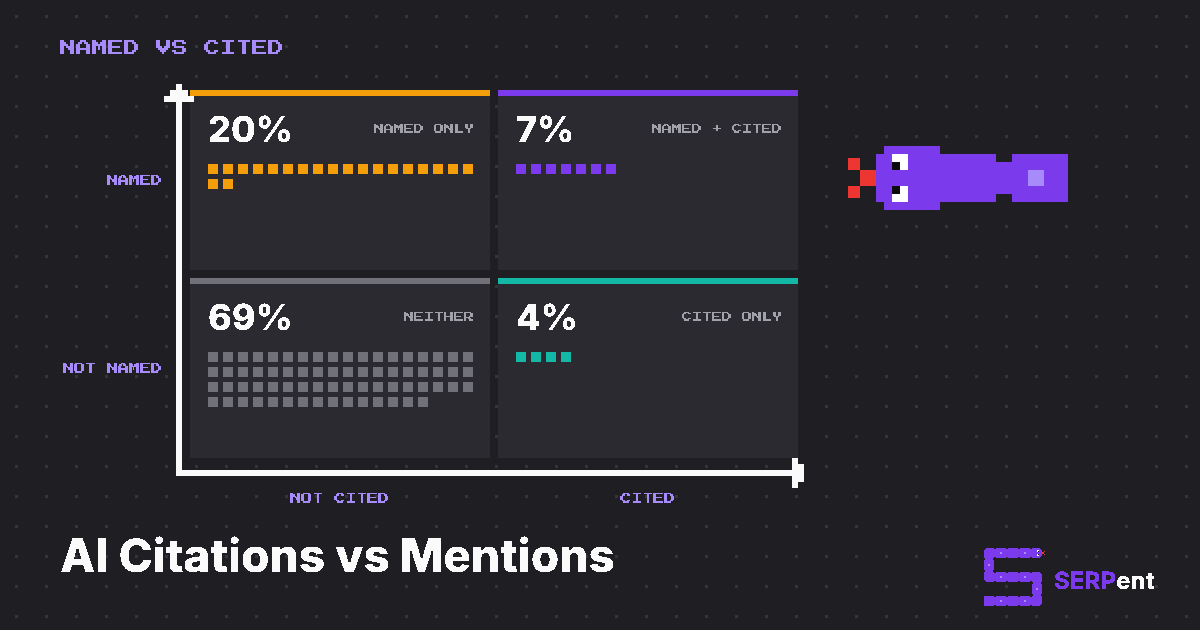
Once you track both, every answer falls into one of four boxes. Here's a made-up example: Northpay, a payroll brand, tracking 20 non-branded prompts in ChatGPT, 3 answers a day for 30 days. That's 1,800 answers.
| Answer type | Answers | Share (n = 1,800) | What it usually means |
|---|---|---|---|
| Named and cited | 126 | 7% | The best case: AI recommends you and links to you |
| Named, not cited | 360 | 20% | Third-party pages are doing the recommending for you |
| Cited, not named | 72 | 4% | Your page answered the question, but AI recommended someone else |
| Neither | 1,242 | 69% | You're not part of this answer at all |
So Northpay's mention rate is 27% (126 + 360 = 486 of 1,800) and its citation rate is 11% (126 + 72 = 198 of 1,800). If you only reported the 11%, you'd tell the client they're losing. If you only reported the 27%, you'd miss the 72 answers where their own page handed the win to a competitor.
That "cited, not named" box is the one I go after first. AI already trusts the page. It just doesn't connect it to a product.
Why mentions and citations don't line up
They're produced by different parts of the system, so they drift apart naturally:
- AI recommends from consensus. Which brands it names is shaped by what lots of sources say: reviews, listicles, forums and its training data. Your own site is one voice in that crowd.
- AI cites what it retrieved. The pages it links to are the ones it fetched to write this answer, often the pages that already rank in search for the question.
- Third-party pages carry both. A listicle can be cited and be the reason three brands get named. Your brand gets the mention while the listicle gets the citation.
It's not a small effect. Semrush's 2026 AI Visibility Index found the overlap between the brands Gemini mentions and the domains it cites can be as low as 30%. Most of the time, the brand being named and the site being cited are different.
Citation rate: what it means and how to calculate it
Citation rate = answers citing at least one page on your domain ÷ all tracked answers.
In the example, that's 198 ÷ 1,800 = 11%. A few rules I stick to:
- Count answers, not links. If one answer cites three of your pages, that's still one answer for citation rate. The number of links matters for the next metric, not this one.
- Use the same denominator as mention rate. If a Google search shows no AI Overview, it goes in both denominators or neither. Mixing them makes the two rates impossible to compare. (We cover that choice in how to track AI Overviews.)
- Show the n. 11% of 1,800 answers is within about 2 points either way. 11% of 18 answers could be almost anything.
AI citation share
Citation rate tells you how often you're cited. Citation share tells you how you're doing against competitors: your domain's share of all the citations that point to the brands you track.
| Domain | Citations | Citation share |
|---|---|---|
| crewcash.com | 310 | 40.8% |
| northpay.com | 240 | 31.6% |
| tillroll.com | 210 | 27.6% |
| Total | 760 | 100% |
It's the citation version of share of voice, and it has the same catch: it depends entirely on which competitors you include. In this example, the same 1,800 answers cited about 3,150 pages in total, and only 760 belonged to the three brands. The other 2,400 or so were review sites, forums and publishers. Those pages don't belong in citation share, but they're the most useful list in the whole report, because they show you who's shaping the answers.
Understanding AI citation tracking: how to track both
You don't need a separate setup for each. One prompt set, run on a schedule, gives you both numbers:
- Start with the right prompts. Non-branded questions your buyers actually ask. Our guide on how to choose prompts to track walks through building the list.
- Run each prompt several times. AI answers change every time you ask, so one run per prompt tells you very little. Three a day for a month is a good base.
- Log two things per answer. Every tracked brand named (and in what order), and every URL cited. Keep them in separate columns, or separate tables.
- Map domains to brands. northpay.com counts for Northpay. Subdomains and country domains count too. A marketplace like a big retailer usually shouldn't, or it'll claim every product page.
- Report per platform. ChatGPT, AI Overviews and AI Mode cite very differently, so never roll them into one number.
- Report the two side by side. Mention rate and citation rate, each with its n, then the cited pages that matter.
If you're doing this by hand in ChatGPT, our ChatGPT brand mentions guide has a logging sheet you can copy.
Which one should you report to a client?
Both, but not with equal weight. For most clients, my headline KPI is mention rate on non-branded prompts, per platform. That's what a buyer actually reads, so it's closest to revenue.
Citations sit right next to it, as the "why". They tell you which pages AI trusts in your category, and they're where the plan comes from. The full set of numbers I'd put in a report is in AI search visibility metrics.
The one exception: if a client's main goal is traffic rather than brand, say a publisher or an affiliate site, citations come first. A mention without a link sends nobody to the site.
How to turn each box into the next one
| If you're... | Do this |
|---|---|
| Cited, not named | Tie the cited page to what you sell: one clear, factual line on who the product is for and what it costs. Then get onto the third-party pages cited in the same answer. |
| Named, not cited | Write the page AI would want to cite for that question: a direct answer near the top, specific numbers, and a page that ranks for the search. |
| Neither | Start with the pages cited in those answers. Get listed in the roundups, answer in the forum threads, and fill in your review profiles. |
| Named and cited | Protect it. Keep the page current, and watch for a competitor's new page taking the citation. |
If you want to see which competitors hold the citations you're missing, that's a citation gap analysis, and I've walked through it in how to benchmark your AI citations vs competitors.
None of this is new, by the way. Getting onto roundups, earning reviews and writing the best page for a question is SEO and digital PR. AI just makes the difference between being talked about and being linked to much easier to see.
How SERPent tracks mentions and citations
I built SERPent to keep these two numbers apart, because blending them was the first thing that went wrong in my own client reports:
- Every answer is read twice: once for the tracked brands named in the text, and once for every page cited. ChatGPT's source chips go to citations, never mentions.
- Mention metrics: seen rate, position among tracked brands, and share of voice, per platform, with branded prompts left out unless you switch them on.
- Citations: the most-cited domains and the pages cited for each prompt, with a flag where you aren't cited. You can export the citations as a CSV.
- Every rate shows its n, so "cited in 11%" always comes with "of 1,800 answers".
It covers Google AI Overviews (using a short seed keyword), AI Mode and ChatGPT (using the full prompt), in the US and Canada, with 3 answers a day per prompt. It doesn't cover Perplexity, Gemini or Claude yet. Plans start at $29 a month for 15 prompts; see pricing.