Every client I've onboarded for AI search asks the same thing within a week: "Are we beating them in ChatGPT?" Usually "them" is the one competitor the founder can't stop thinking about.
It's a fair question, and it's one you can actually answer, as long as you don't do it by typing a prompt into ChatGPT once and screenshotting the result. AI answers change every time you ask. In SparkToro's January 2026 research, the same prompt almost never produced the same list of brands twice. One screenshot is an anecdote. A benchmark is a sample.
Here's how I benchmark a brand's AI mentions and citations against its competitors, the same way I'd benchmark rankings for an SEO client.
To benchmark your AI citations vs competitors: track the same non-branded prompts for you and 3 to 5 competitors, on each AI platform separately, with several runs per prompt. Compare four numbers per brand: seen rate, share of voice, median position when named, and how often each brand's own pages are cited.
Then find the gaps: the pages AI cites in answers that name your competitors but not you. That list is your content and outreach plan.
Mentions vs citations: benchmark both
Before the setup, one distinction that trips people up. AI answers give you two different signals:
- A mention is your brand named in the answer text: "Tallyhub and Brightbook are both popular with small firms."
- A citation is a link to a page the answer used as a source: a review site, a Reddit thread, a competitor's comparison page, or your own blog.
They don't move together. AI can recommend you without citing a single page of yours, and it can cite your blog post while recommending a competitor. So a proper benchmark tracks both, for you and for every competitor.
How to conduct competitive benchmarking for generative AI presence
This is the process I use for agency clients. It's basically the same thing we've always done for rankings, with one difference: you're measuring a rate over many answers, not one position.
1. Pick the competitors, and let AI correct you
Start with the 3 to 5 businesses buyers actually compare you with. Sales teams know this list.
Then check it against what AI actually says. After a week of data, look at which other brands keep showing up in the answers for your prompts. It's common to find a brand the client has never worried about named in a third of the answers. If AI keeps naming it, it's a competitor in AI search, whether you like it or not.
Keep two lists apart:
- Business competitors: brands that sell what you sell.
- Content sources: sites that get cited but don't compete with you, such as G2, Reddit, YouTube or a trade publication. These matter for citation gaps, not for share of voice.
2. Use the same prompts for everyone
The benchmark only works if every brand is measured on the same questions. Build one prompt set and track all the competitors against it. Our guide on how to choose prompts to track goes deep on this, but the short version:
- Non-branded prompts only for the benchmark: "best accounting software for a small firm", not "is Brightbook any good?" A prompt with your name in it hands you the win.
- Track comparison prompts separately. "Brightbook vs Tallyhub" is useful to watch, but it's rigged by design: both brands get named almost every time.
- 20 to 50 prompts per client covers most categories. Fewer than about 15 and one odd prompt can swing the whole result.
3. Measure each platform and market on its own
ChatGPT, Google AI Overviews and Google AI Mode get different inputs and lean on different sources. A competitor can lead in ChatGPT and barely show up in AI Overviews. If you average the three into one score, you won't see that, and that's exactly the thing you need to see.
Same with markets. The same prompt gets different brands in the US and Canada, so benchmark one market at a time.
4. Collect enough answers
This is where most quick audits go wrong. Ten prompts run once each is 10 answers, and the margin of error on 10 answers is enormous. You need repeated runs over days or weeks before the comparison means anything. I'll show the numbers below.
5. Calculate four numbers per brand
For each brand on each platform, over the same period:
| Benchmark | What it tells you | How it's calculated |
|---|---|---|
| Seen rate | How often AI names the brand at all | Answers naming the brand ÷ all answers |
| Share of voice | Who owns the conversation | The brand's mentions ÷ all tracked-brand mentions |
| Position when named | Whether the brand is named first or as an afterthought | Median order among tracked brands, in answers that name it |
| Cited rate | Whether AI reads and trusts the brand's own pages | Answers citing the brand's domain ÷ answers |
If you want the formulas and the reporting rules for each one, I covered them in AI search visibility metrics and what is share of voice in AI search.
6. Pull the citation gaps
Last step, and the one that turns a report into a plan: list the pages AI cites in answers that name your competitors but not you. More on that below.
What a competitor benchmark looks like
Here's an illustrative example. A small-business accounting tool, Brightbook, tracked in ChatGPT in the US against three competitors: 25 non-branded prompts, 3 runs a day for 30 days. That's 2,250 answers, and 2,835 brand mentions across the four brands.
| Brand | Seen rate | Share of voice | Position when named | Cited rate |
|---|---|---|---|---|
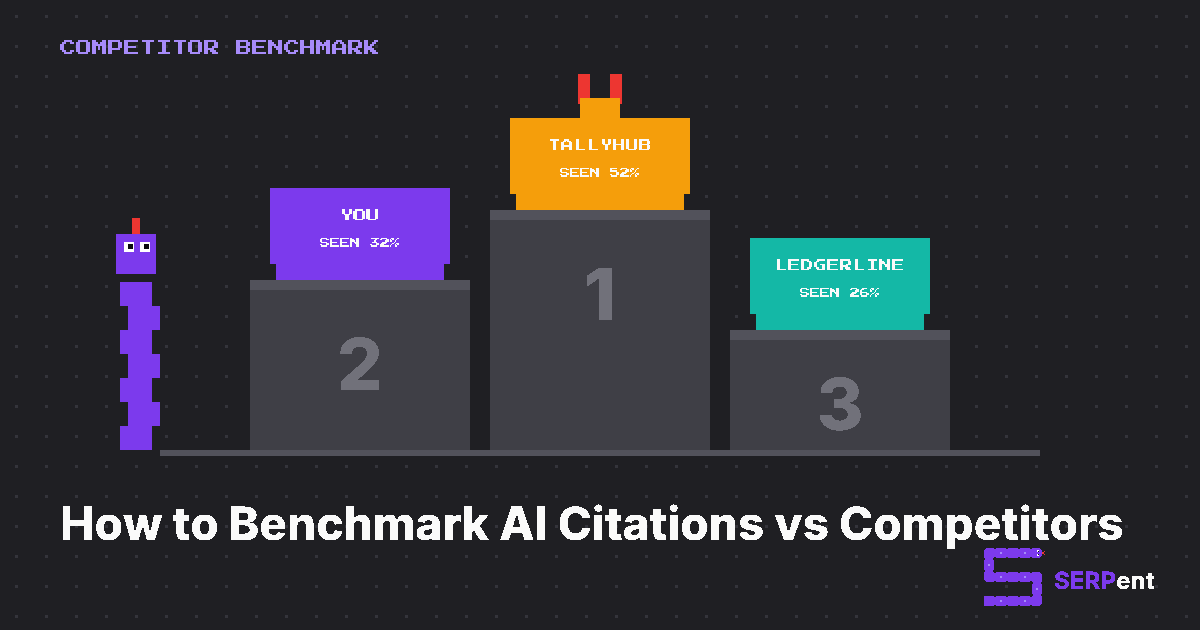
| Tallyhub | 52% (1,170 of 2,250) | 41% (1,170 of 2,835) | #1 | 24% (540 of 2,250) |
| Brightbook (you) | 32% (720 of 2,250) | 25% (720 of 2,835) | #2 | 13% (293 of 2,250) |
| Ledgerline | 26% (585 of 2,250) | 21% (585 of 2,835) | #3 | 7% (158 of 2,250) |
| Countwise | 16% (360 of 2,250) | 13% (360 of 2,835) | #2 | 11% (248 of 2,250) |
Here's how I'd read that for the client:
- Tallyhub is the one to beat, and not by a little: it's named in more than half the answers and usually first. Its pages are also cited about twice as often as Brightbook's, which tells me AI trusts its content, not just its brand.
- Brightbook is a clear second. A 32% seen rate on 2,250 answers is solid. The gap to Tallyhub is 20 points, far outside the noise.
- Countwise is the interesting one. It's only named in 16% of answers, but its pages are cited in 11%, almost as often as Brightbook's. AI is reading its content even when it isn't recommending it. That usually means strong guides or comparison pages, and it's worth a look before it turns into recommendations.
- Every number has its n. The client can check every rate, and a junior on the team can't accidentally turn 3 answers into "100%".
Then I'd repeat the same table for Google AI Overviews and AI Mode, because the order often changes.
How to monitor competitor mentions in AI search results
A one-off benchmark is a snapshot. The value is in watching it move. Once the setup is fixed, monitoring is mostly a weekly habit:
- Check each competitor's seen rate and share of voice week over week, per platform. Small moves are noise; look for changes bigger than the margin of error.
- Find the prompts that moved most. When a competitor jumps, it's rarely across the board. It's usually 2 or 3 prompts where a new source started getting cited.
- Read those answers. Open the actual responses and look at what's cited. Nine times out of ten you'll find a fresh listicle, a review page or a Reddit thread that names them and not you.
- Keep the setup frozen. If you add prompts or competitors mid-month, note it in the report, or you'll be comparing different things.
How to track competitors in Google AI Overviews
AI Overviews need slightly different handling from ChatGPT and AI Mode:
- Track keywords, not prompts. People type short searches into Google, like "accounting software for small business", not a conversational question. Use the keyword they'd actually search, and give AI Mode and ChatGPT the full prompt. That's how our Google AI Overview tracker works.
- Not every search shows an AI Overview. Decide how you count those. Counting a search with no AI Overview as "not mentioned" tells you how often a searcher actually saw each brand. Counting only searches where one appeared tells you who wins once it shows. Both are fair; just label which one you're reporting and use the same one for every competitor.
- Watch the citations closely. AI Overviews lean heavily on pages that already rank. If a competitor is cited and you aren't, look at whether their page outranks yours for that keyword in normal search. Often that's the whole story, and the fix is plain SEO.
How to track competitor rankings in AI search results
There's no rank 1 in an AI answer, but there is an order. When an answer names four brands, being named first matters, especially in ChatGPT, where people skim.
Track position when named: where each brand appears among the tracked brands in the answers that name it. Use the median over the period, not one answer's order, because the order shuffles from run to run.
And always read it next to seen rate. A competitor named first in 5 answers out of 2,250 has a great position and almost no visibility. "#2 when named, seen in 32% of answers" is the honest version.
Find the citation gaps
This is the part clients actually act on. A citation gap is a page AI cites in answers that name your competitors but not you. Sort them into types, because each one needs a different move:
| Cited page | Example | What to do |
|---|---|---|
| Listicle or review roundup | "Best accounting software for 2026" | Pitch the author with something new: data, a free tier, a use case they missed |
| Forum thread | A Reddit thread asking for recommendations | Have a real person from the team answer, honestly and with disclosure |
| Directory or marketplace | G2, Capterra, an app marketplace | Get listed, fill the profile in, and ask happy customers for reviews |
| Video | A YouTube walkthrough | Sponsor a creator or publish your own walkthrough |
| Competitor content | A competitor's comparison page or guide | Write a better page on the same question, and make sure it ranks |
Start with the pages cited most often across the most prompts. One listicle cited in 30% of the answers for your category is worth more than ten pages cited once.
This is where GEO stops looking like something new. Getting into listicles, earning reviews, answering in forums and writing better pages than your competitors is SEO and digital PR. The only real difference is that third-party mentions count for more, because AI leans on what other sites say about you.
How many answers you need
A quick rule of thumb: the margin of error on a rate is about 1 ÷ √n, where n is the number of answers behind it.
| Answers (n) | Where that comes from | Margin of error, roughly |
|---|---|---|
| 10 | 10 prompts, run once | ±32 points |
| 90 | 1 prompt, 3 runs a day for 30 days | ±11 points |
| 450 | 5 prompts, 3 runs a day for 30 days | ±5 points |
| 2,250 | 25 prompts, 3 runs a day for 30 days | ±2 points |
So in the example above, the 20-point gap between Tallyhub and Brightbook is real, and the 6-point gap between Brightbook and Ledgerline is too. But if a single prompt shows Brightbook at 40% and Ledgerline at 33%, that's within the noise. Compare brands across the whole prompt set, and use single prompts to find out why, not to declare a winner.
Five mistakes that wreck a competitor benchmark
- Blending platforms. One "AI visibility score" across ChatGPT, AI Overviews and AI Mode hides the platform where you're losing.
- Counting branded prompts. Your own name in the prompt guarantees a mention. Keep those out of the comparison.
- Changing the competitor list mid-period. Share of voice depends on who's in the set. Add a competitor and everyone else's share drops, even if nothing changed in the answers.
- Too few answers. If a rate doesn't come with its n, nobody can tell a real gap from noise.
- Benchmarking only mentions. The citations tell you why a competitor is winning, and that's where the plan comes from.
How I do this in SERPent
I built SERPent because I was doing this in spreadsheets for clients. Here's what it covers today:
- Competitors shows each brand's share of voice on each platform, with "seen in x of n runs" next to it. Branded prompts are left out unless you switch them on.
- Overview shows your seen rate, how many prompts mention you, your share-of-voice rank, and the prompts with the biggest gains and losses.
- Rankings shows where each brand is named among the tracked brands.
- Citations lists every cited URL with its median position and the runs citing it, by prompt, and you can export the citations as CSV.
- Actions (beta) lists citation opportunities, the forums, listicles, directories, blogs and videos cited where you aren't, plus competitor content to outrank and brands that keep showing up that you don't track yet.
Every prompt gets 3 answers a day on Google AI Overviews, AI Mode and ChatGPT, so a month of 25 prompts gives you the 2,250-answer benchmark above on each platform. What it doesn't do yet: Perplexity, Gemini or Claude, sentiment scoring, or markets outside the US and Canada.
Plans start at $29 a month for 15 prompts. The Agency plan is $249 a month for 200 prompts across up to 10 client sites, with each client's competitors kept separate. See pricing for the details.