Ask an SEO what to report and you'll get a short list: rankings, impressions, clicks, conversions. Ask the same question about ChatGPT or Google's AI Overviews and the list falls apart. There's no position 1 in an AI answer, the answer changes every time you ask, and most of the people who read it never click.
So AI search needs its own metrics. This guide covers the AI search visibility metrics that matter, how each one is calculated, which ones make good KPIs for generative engine optimization (GEO), and how to report them without overstating what the data can prove.
The core AI search visibility metrics are: mention rate (how often answers name you), position when mentioned, share of voice against named competitors, citation rate (how often answers cite your pages), and AI referral traffic and conversions.
The KPIs to track for GEO: one headline mention rate per platform on non-branded prompts, share of voice, citation rate, and AI referral conversions. Report each platform separately, and every rate with the number of answers behind it.
What are AI search visibility metrics?
AI search visibility metrics measure how a brand appears in answers generated by AI: Google AI Overviews, Google AI Mode, ChatGPT and similar tools. They differ from SEO metrics in three ways.
- They're rates, not positions. A Google ranking is one number for a keyword on a given day. An AI answer is a sample: ask again and you may get different brands in a different order. In SparkToro's January 2026 study of 2,961 AI answers, the chance of getting the same list of brands twice in 100 runs was under 1 in 100. So the useful number is how often you appear across many runs.
- They're relative to a competitor set. Being named in an answer only means something next to the brands named with you. Several metrics depend on which competitors you track.
- They're per platform. AI Overviews, AI Mode and ChatGPT get different inputs and cite different sources. Ahrefs found AI Overviews and AI Mode cited the same URLs only 13.7% of the time for the same queries. A blended number describes none of them.
The AI visibility metrics that matter
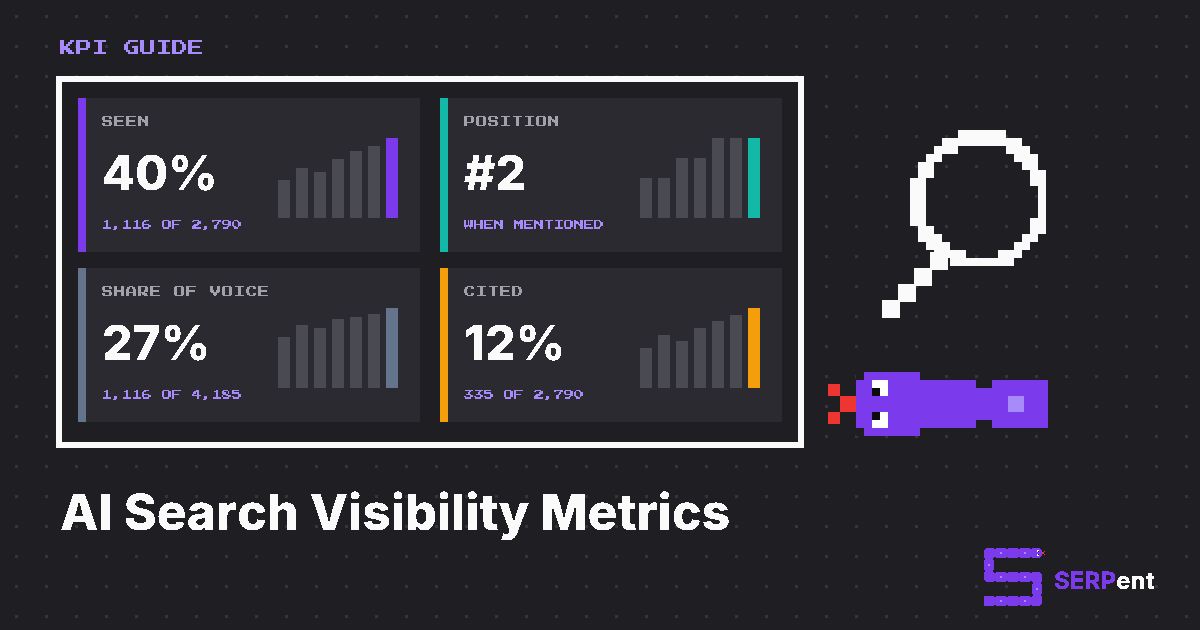
Here's the full set, with the question each one answers. The examples come from one illustrative client tracked on ChatGPT in the US for October: 30 non-branded prompts, each run 3 times a day for 31 days, which gives 2,790 runs.
| Metric | The question it answers | How it's calculated | Example |
|---|---|---|---|
| Mention rate (seen rate) | Does AI name us? | Runs that name the brand ÷ all runs | 40% (1,116 of 2,790) |
| Prompt coverage | On how many topics? | Prompts where the brand was named at least once ÷ prompts tracked | 19 of 30 prompts |
| Position when mentioned | Are we named first or last? | Median rank among tracked brands, in answers that name the brand | #2 |
| Share of voice | How much of the conversation is ours? | Brand mentions ÷ all tracked-brand mentions | 27% (1,116 of 4,185) |
| Citation rate | Does AI read and link our pages? | Answered runs citing our domain ÷ answered runs | 12% (335 of 2,790) |
| Top cited domains | Which sources shape the answers? | Answered runs citing each domain ÷ answered runs | A review site in 31% |
| AI referral sessions and conversions | Does it bring business? | From GA4 and Search Console, not from answers | 212 sessions, 9 sign-ups |
Mention rate: the headline visibility metric
Mention rate is the share of runs in which AI names your brand. It goes by several names: visibility, seen rate, presence or brand mention rate. It's the closest thing AI search has to a ranking, and it's the best single headline number, as long as two rules hold:
- Non-branded prompts only. A prompt with your name in it ("Is Ledgerly good for small firms?") gets an answer that names you almost every time. Mix those prompts in and your rate climbs with no change in how AI treats your category. Track branded prompts separately, as an accuracy check.
- Decide what counts as a run. For Google AI Overviews, many searches show no AI Overview at all. Counting those checks as "not mentioned" tells you how often a searcher actually saw you. Counting only the checks where an AI Overview appeared tells you how you do once one shows up. Both are useful; label which one you report.
Position when mentioned
Position is the order your brand appears in among the tracked brands in an answer: named first, second, third. On its own it misleads, because a brand named once, first, in 100 answers has a perfect position and almost no visibility. Always read it together with mention rate: "#2 when mentioned, seen in 40% of answers."
Use the median over many answers, not a single answer's order, for the same reason SparkToro gave: brand order within one answer is close to random from run to run.
Share of voice
Share of voice is your share of all the brand mentions in the answers, out of the competitors you track. Where mention rate asks "are we in the answer?", share of voice asks "are we winning it?". It depends heavily on which competitors you include. We've covered the formula, the denominator problem and how to report it in what is share of voice in AI search, so here it's enough to say it belongs in every report next to mention rate.
Citation metrics: being read vs being named
A mention is your brand in the answer text. A citation is a link to a source page. They don't move together: AI can recommend you without linking to your site, and cite your blog post while recommending a competitor. Track:
- Citation rate: how often answers cite at least one page on your domain.
- Top cited domains: the sites AI relies on in your category, often review sites, listicles, forums and YouTube. In SERPent's own tracking of 8,002 AI Overviews, 29.8% cited at least one YouTube video (see how to track AI Overviews).
- Citation gaps: pages cited in answers that name competitors but not you. These are your outreach and content list.
AI referral traffic and conversions
Visibility metrics measure answers, not visits. To connect them to revenue, pull traffic from your analytics:
- ChatGPT and other assistants: GA4 now has an AI Assistant channel for visits from sources like ChatGPT, Gemini and Copilot. Expect undercounting: app visits and copied links often arrive as Direct.
- Google AI Overviews and AI Mode: these stay in Organic Search in GA4, and Google reports their clicks within the "Web" search type in Search Console, with no filter to separate them. The generative AI performance report Google added in June 2026 shows impressions in AI features by page, but not clicks or queries.
Treat traffic as the outcome and visibility as the leading indicator. Traffic tells you whether it paid off; visibility tells you why. For setup steps, see how to track AI Mode traffic and the GA4 section of how to track brand mentions on ChatGPT.
Brand accuracy and sentiment
The last question is whether AI describes you correctly: your pricing, features, locations and who you're for. Some tools score sentiment automatically. SERPent doesn't score sentiment yet; today the practical check is to read the answers to your branded prompts each month and log anything wrong.
KPIs to track for GEO
Not every metric is a KPI. A KPI is a number you commit to moving and report every period; the rest are diagnostics you open when a KPI moves. For most brands and agency clients, this set works:
| Tier | KPI | Why it's there |
|---|---|---|
| Headline | Mention rate on non-branded prompts, per platform | The clearest answer to "are we showing up in AI search?" |
| Competitive | Share of voice and share-of-voice rank | Shows whether you're gaining on the brands buyers compare you with |
| Source | Citation rate on your domain | Shows whether your own pages are being read and trusted |
| Outcome | AI referral sessions and conversions | Connects the work to leads and revenue |
Diagnostics to keep one click away: position when mentioned, prompt coverage, top cited domains, citation gaps, the prompts that moved most, and the AI Overview appearance rate for your keywords.
Five rules make these KPIs hold up:
- One line per platform. Google AI Overviews, Google AI Mode and ChatGPT each get their own numbers. Never average them into one "AI visibility score".
- One market at a time. The same prompt gets different answers in the US and Canada. In SERPent's tracking, AI Overviews appeared on 90.9% of US checks (7,085) and 82.1% of Canadian ones (1,903).
- Branded prompts out of the headline. Report them separately.
- A frozen setup. Keep the prompt list and competitor list the same for the whole period, and note any change in the report. See how to choose prompts to track for building the list.
- Every rate with its n. "40% (1,116 of 2,790 runs)" can be checked. "40%" can't.
KPIs for GEO vs SEO
Most GEO KPIs have an SEO ancestor. The difference is that each one becomes a rate over a sample instead of a single observation.
| SEO KPI | GEO equivalent | What changes |
|---|---|---|
| Keyword rankings | Mention rate and position when mentioned | Measured over many runs, not one check a day |
| Share of search | Share of voice | Counts mentions in answers, not searches or clicks |
| Backlinks | Citations and cited domains | The pages AI links to, which overlap only partly with Google's top results |
| Impressions | AI feature impressions (Search Console generative AI report) | By page only, AI Overviews and AI Mode combined |
| Organic clicks and sessions | AI referral sessions | Partly hidden: Google AI clicks sit inside organic, app visits land in Direct |
| Keyword search volume | No reliable equivalent | Prompt volumes are estimates; weight with care |
The overlap between the two is real but partial. In SERPent's own AI Overview data, 28.7% of 38,206 cited URLs also ranked on Google's organic page one. Good SEO helps, but ranking well doesn't guarantee being cited, so the two sets of KPIs belong side by side rather than one replacing the other.
KPIs for AEO and GEO: are they different?
No. Answer engine optimization (AEO) and generative engine optimization (GEO) are two names for the same goal: getting your brand named and your pages cited in AI-generated answers. The KPIs are the same. What does change is the platform, and that matters more than the label: a GEO report that only covers ChatGPT misses Google's AI Overviews and AI Mode, and a report that only covers Google misses ChatGPT.
How to measure GEO success
GEO success is a change in the KPIs above that's bigger than the noise and that you can tie to work you did. A simple method:
- Fix the setup. Prompts, competitors, platforms and market, frozen for the period.
- Take a four-week baseline before you change anything.
- Check the sample size. The margin of error on a rate is roughly 1 ÷ √n. With 2,790 runs a month, that's about ±2 points; with 90 runs (one prompt for a month) it's about ±11. Read changes at the level where the n supports them: client-wide first, single prompts only for big moves.
- Compare like with like. Same prompts and competitors this month and last. A new competitor lowers everyone's share of voice without any change in the answers.
- Tie the move to a cause. Did the pages you updated start getting cited? Did you get listed on a review site that AI cites often? Use citations by prompt and the prompts that moved most to find out.
- Then check the outcome. AI referral sessions and conversions should follow visibility, with a lag and with undercounting.
AI visibility metrics to be careful with
Some numbers look good in a dashboard and don't survive a client's questions:
- A single blended "AI visibility score". It averages platforms that behave differently and hides where you're weak.
- Visibility that includes branded prompts. It inflates the number with answers you were always going to get.
- Rank from one answer. Brand order in a single answer is close to random; use a median over many.
- Rates with no n. 50% from 4 runs and 50% from 4,000 runs aren't the same finding.
- Prompt volume as fact. Nobody outside OpenAI and Google knows how often a prompt is asked. Volume estimates can help you choose prompts, but don't weight KPIs by them without saying so.
AI visibility tracking success metrics: a monthly scorecard
For an agency client, one table per platform covers most of a monthly report. Put the scope above it, then the KPIs with this period, last period and the counts:
ChatGPT, United States, October 1 to 31: 30 non-branded prompts, 5 tracked brands, 2,790 runs. Branded prompts excluded.
| KPI | September | October | Counts (October) |
|---|---|---|---|
| Mention rate | 34% | 40% | 1,116 of 2,790 runs |
| Position when mentioned | #3 | #2 | Median over 1,116 answers |
| Share of voice (rank) | 23% (3rd) | 27% (2nd) | 1,116 of 4,185 mentions |
| Citation rate | 9% | 12% | 335 of 2,790 runs |
| Prompts mentioning the client | 16 of 30 | 19 of 30 | |
| AI Assistant sessions (GA4) | 164 | 212 | 9 sign-ups |
Then repeat the table for Google AI Overviews and AI Mode, add the three prompts that moved most, and list the cited pages behind the change. Illustrative numbers; your own will differ.
Which AI visibility metrics SERPent tracks
SERPent tracks Google AI Overviews (with seed keywords), Google AI Mode and ChatGPT (with full prompts), in the US and Canada. Each prompt runs 3 times a day on each platform, and every rate shows its n. For each platform it reports:
- Seen: the share of runs that mention the brand, counting runs with no AI answer as not seen.
- Position when mentioned: the brand's median rank among tracked brands, in answers that mention it, plus the best position and the change against the previous period.
- Share of voice and share-of-voice rank, with branded prompts left out by default.
- Prompts mentioning you, and the prompts that gained or lost the most.
- Top cited domains and citations by prompt, with a CSV export of every cited page.
- Actions (beta): the pages cited where competitors are named and you aren't.
What it doesn't do yet: sentiment scoring, an API, and traffic data (use GA4 and Search Console for that, as above). Gemini, Perplexity and Claude are listed as coming-soon add-ons on the pricing page. Plans start at $29 a month for 15 prompts, and the Agency plan covers 200 prompts across 10 client sites for $249.
AI search visibility metrics: FAQ
What are AI search visibility metrics?
They're the numbers that describe how a brand shows up in AI-generated answers: how often it's named (mention rate), where it's named among competitors (position), its share of all brand mentions (share of voice), how often its pages are cited as sources, and the traffic those answers send. Each one is measured over a sample of answers to a fixed set of prompts.
What KPIs should I track for GEO?
Pick one headline KPI per platform, usually mention rate on non-branded prompts, plus share of voice against named competitors and your citation rate. Add AI referral sessions and conversions from GA4 as the business outcome. Keep everything else as diagnostics.
Are the KPIs for AEO and GEO different?
No. AEO and GEO describe the same goal, getting named and cited in AI answers, so they use the same metrics: mention rate, position, share of voice, citations and AI referral traffic. What changes is the platform you measure, so report Google AI Overviews, AI Mode and ChatGPT separately.
How are GEO KPIs different from SEO KPIs?
SEO KPIs measure one stable ranking per keyword and the clicks it earns. GEO KPIs measure a rate over many answers, because AI answers change from run to run. Rankings become mention rate and position, backlinks become citations, share of search becomes share of voice, and organic traffic becomes AI referral traffic, which is only partly visible in analytics.
How do you measure GEO success?
Fix your prompts, competitors and platforms, take a four-week baseline, then compare each later period with it on the same setup. Count a change only when it's bigger than the margin of error for the number of answers behind it, and tie it to the pages you changed or the sources you won.
What is a good AI visibility score?
There isn't a standard one, and a single blended score hides more than it shows. Compare your mention rate and share of voice with the competitors in your own tracked set, and with your own trend on the same prompts. A brand can lead in ChatGPT and trail in AI Overviews, so judge each platform on its own.
How many answers do you need for a reliable AI visibility metric?
As a rule of thumb the margin of error is about 1 divided by the square root of n. 100 answers give roughly plus or minus 10 points, 400 give about 5, and 2,500 give about 2. Report every rate with its n so readers can tell a real move from noise.
Can I track AI brand sentiment in SERPent?
Not yet. SERPent records whether and where a brand is named and which pages are cited, but it doesn't score sentiment today. Until it does, read the answer text for your branded prompts to check that AI describes you accurately.