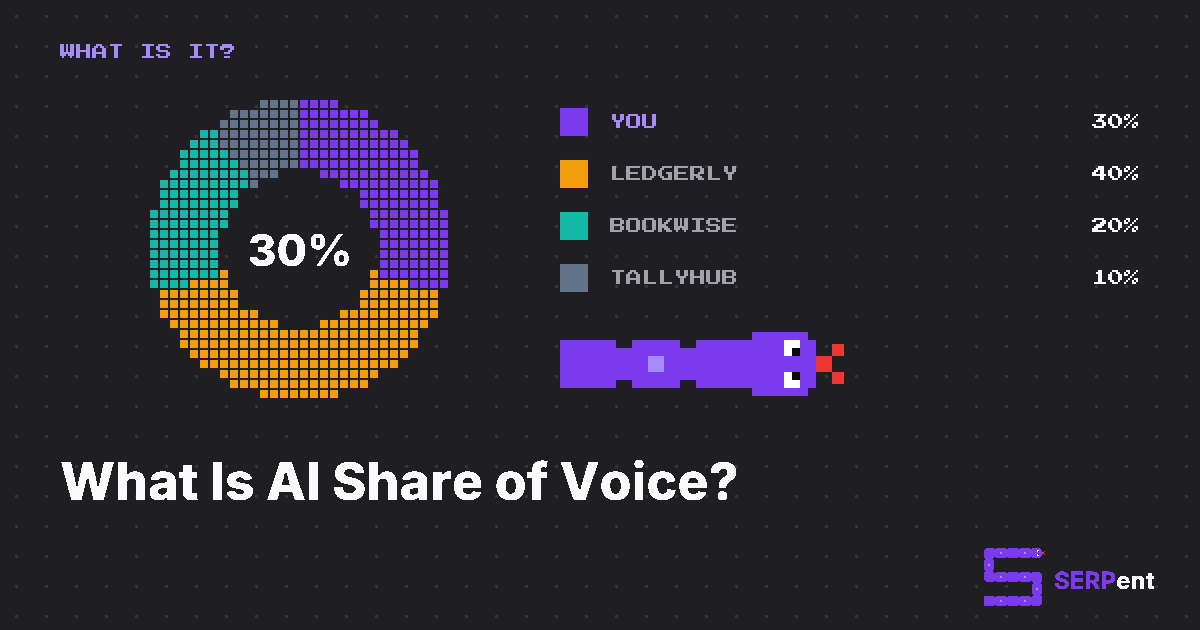
Ask ChatGPT for the best bookkeeping software for a small firm 10 times, and it might name your brand in 6 of the answers. That sounds like 60% of AI search. It isn't. Across those 10 answers, ChatGPT also named your competitors 14 times, so your brand has only 6 of 20 mentions. Your share of voice is 30%.
AI share of voice is the closest thing AI search has to market share: how much of the conversation in AI answers belongs to you, compared with the brands you compete with. This guide explains what it is, how to calculate it, why tools report different numbers for the same brand, and how to report it to a client without overstating it.
Share of voice in AI search is your brand's share of all brand mentions in AI-generated answers, measured across a fixed set of prompts and the competitors you track.
AI share of voice = your mentions ÷ all tracked-brand mentions × 100
Calculate it per platform (Google AI Overviews, AI Mode and ChatGPT separately), leave out prompts that name your brand, and always state how many answers it's based on.
What is share of voice in AI search?
Share of voice started in advertising. It meant a brand's share of all the media spend or ad exposure in its category, and it was usually compared with the brand's share of the market. John Philip Jones made that comparison famous in Harvard Business Review in 1990, and Nielsen still defines it as a brand's share of category media spend.
AI search changes what's being counted. There's no ad slot to buy in a ChatGPT answer or a Google AI Overview. Instead, the AI names some brands and leaves others out. So share of voice in AI answers, whether they come from Google, ChatGPT or any other generative AI search engine, means your share of the brand mentions in those answers, out of all mentions of the brands you track.
You'll also see it called share of model. Tom Roach of the agency Jellyfish popularized that name in Marketing Week in July 2024, describing it as a brand's share of large language model mentions in its category. It's the same idea.
Share of voice answers a competitive question: when AI talks about your category, how much of the conversation is about you? That makes it different from the other AI visibility metrics:
| Metric | What it measures | Example |
|---|---|---|
| Mention rate (or seen rate, or visibility) | The share of answers that name your brand | Named in 6 of 10 answers: 60% |
| Share of voice | Your share of all tracked-brand mentions | 6 of 20 mentions: 30% |
| Position | Where your brand appears among the brands named in an answer | Usually named second |
| Citation share | Your share of the pages the AI links to as sources | 4 of 25 cited pages: 16% |
How to calculate AI share of voice
The calculation is simple once the counting is consistent. Here's a worked example: 10 AI answers to the same set of prompts, with 4 tracked brands.
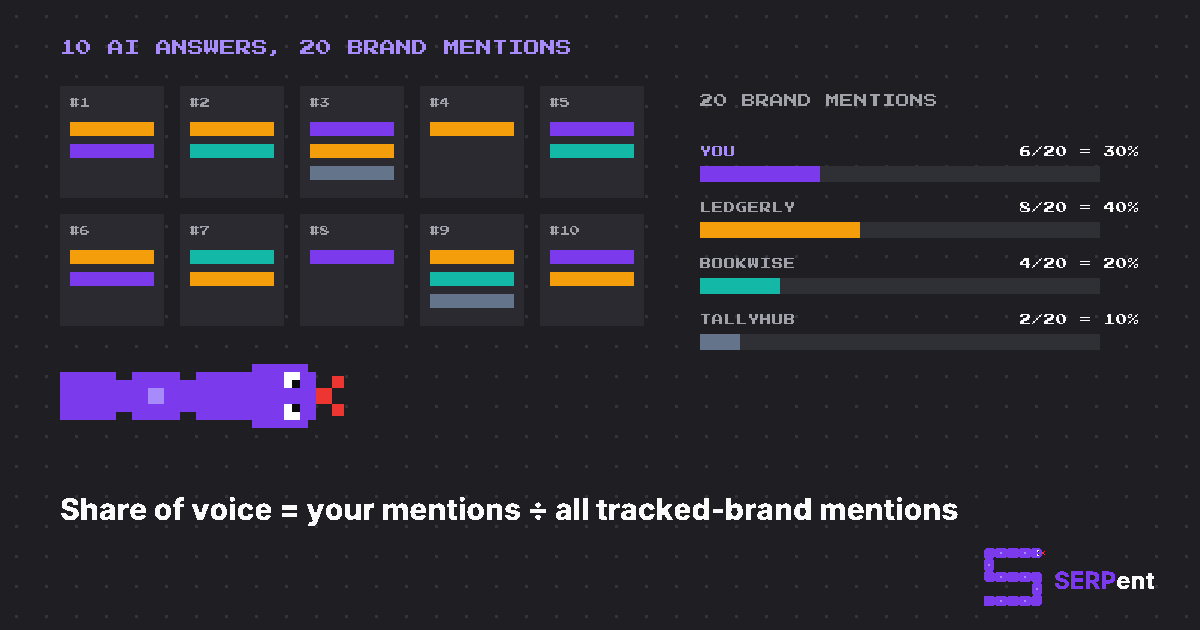
- Count the answers that name each brand. A brand counts once per answer, however many times the answer repeats its name. Here: You 6, Ledgerly 8, Bookwise 4, Tallyhub 2.
- Add the counts together. 6 + 8 + 4 + 2 = 20 brand mentions.
- Divide each brand's count by the total. You: 6 ÷ 20 = 30%. Ledgerly: 40%. Bookwise: 20%. Tallyhub: 10%.
Shares of voice always add up to 100%, which is what makes them easy to compare. Mention rates don't: in this example, the four brands' mention rates add up to 200%, because most answers name more than one brand.
Notice the gap between the two numbers for your brand. You're named in 60% of answers, which sounds strong, but Ledgerly is named more often and takes a bigger share of the conversation. Mention rate tells you whether you're in the answers. Share of voice tells you whether you're winning them.
Why tools report different share of voice for the same brand
There isn't one standard formula. AI visibility tools use several, and the same data gives a different answer under each. Here's our 10-answer example run through the common variants:
| Formula | How it works | Your score |
|---|---|---|
| Mention share | Your mentions ÷ all tracked-brand mentions | 30% |
| Mention rate (often labeled visibility) | Answers that name you ÷ all answers | 60% |
| Position-weighted share | Named first = 1 point, second = ½, third = ⅓; your points ÷ all points | 34% |
| First-mention share | Answers that name you first ÷ all answers | 40% |
| Volume-weighted share | Each prompt weighted by its estimated search volume | Depends on the volumes used |
Same answers, four different numbers between 30% and 60%. None of them is wrong, but they aren't interchangeable. Before you compare two tools, or put a number in a client report, find out which formula it uses.
There's a second source of disagreement: inputs. Two tools with the same formula will still differ if they track different prompts, competitors, platforms or countries. And position-weighted formulas lean on a shaky input. In SparkToro's January 2026 study of 2,961 AI answers, the chance of getting the same brand list twice in 100 runs was under 1 in 100, and the chance of the same order was lower still. SparkToro concluded that visibility measured across many runs is a reasonable metric, while the rank of a brand within a single answer isn't.
That's why SERPent reports share of voice as a plain mention share, and shows position separately, as an average over many answers, rather than baking it into the share.
Who's in the denominator changes everything
Share of voice is relative, so the list of brands you track decides the number as much as the AI does.
- Remove a competitor and your share goes up. Drop Tallyhub from our example and your share rises from 30% to 33% (6 of 18), though nothing changed in the answers.
- Add one and it goes down. Add a competitor that AI named 10 times in the same answers, and your share falls to 20% (6 of 30).
Three rules keep the denominator honest:
- Track the competitors buyers actually compare you with, including the ones that keep appearing in AI answers even if you don't think of them as rivals.
- Keep publishers, directories and review sites out. A listicle site that AI mentions often isn't a competitor for share of voice. In SERPent, you can mark a brand as a source: its mentions and citations are still recorded, but it leaves share of voice and the competitor rankings.
- Freeze the list for each reporting period. If you add a competitor, note it in the report, because the share will move for a reason that has nothing to do with your work.
Leave branded prompts out
A prompt with your brand name in it ("Is Ledgerly good for small firms?") gets an answer that names you almost every time. Mix those prompts in and your share of voice climbs for free.
Back to the example: add 5 answers to branded prompts that all name you (and name Ledgerly twice). Your share jumps from 30% to 41% (11 of 27 mentions), without any change in how AI treats you when buyers ask about the category.
So calculate share of voice over organic and competitor prompts only, and track branded prompts separately as an accuracy check: is the AI describing your pricing, features and locations correctly? SERPent leaves branded prompts out of share of voice by default. You can switch them in, and it shows a warning when you do. For how to build the prompt list in the first place, see how to choose prompts to track.
Report share of voice per platform, not blended
Google AI Overviews, Google AI Mode and ChatGPT are different products. They get different inputs, read different sources and recommend different brands. Ahrefs found that AI Overviews and AI Mode cited the same URLs only 13.7% of the time for the same queries (September 2025 data). So the same brand can hold very different shares on each:
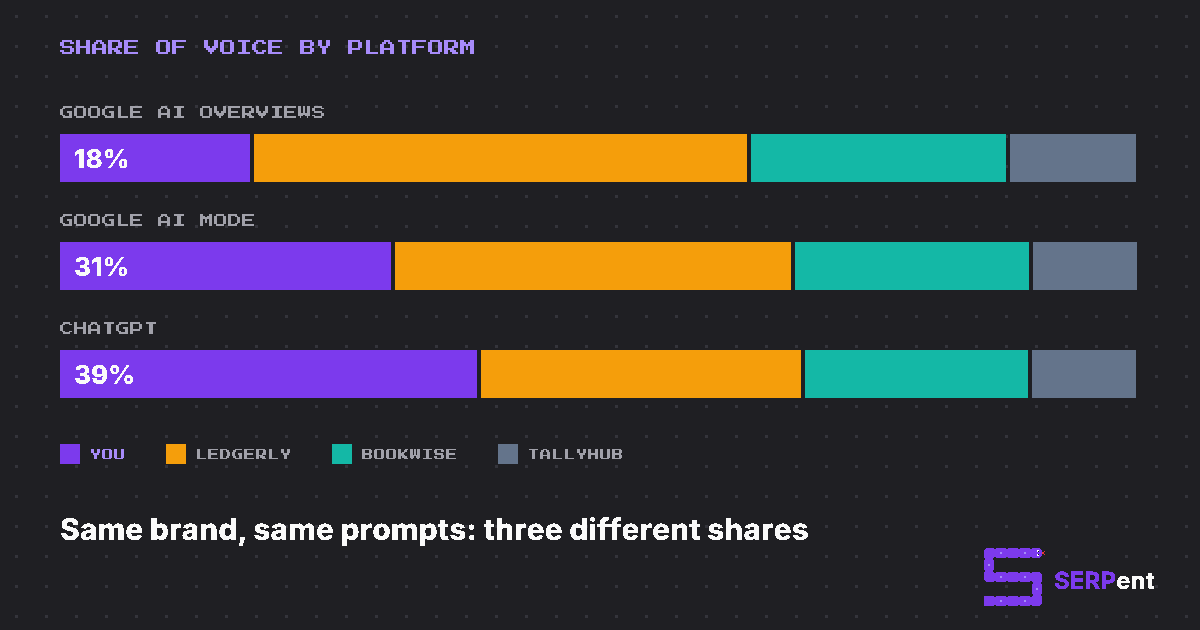
Average those three and you get roughly 29%, a number that describes none of them and hides the real story: this brand is losing in AI Overviews. Report each platform on its own line. If you must give one number, calculate it from the raw counts across platforms, not by averaging percentages, and say how the platforms were combined.
The platforms also need different inputs. AI Overviews appear on Google searches, so they're tracked with seed keywords; AI Mode and ChatGPT are tracked with full prompts. That's how SERPent works: share of voice is shown per platform, for Google AI Overviews, Google AI Mode and ChatGPT, and never combined into one score.
How many answers you need before it means anything
A share of voice is an estimate from a sample of answers, and small samples swing. As a rough rule of thumb, the margin of error on a percentage is about 1 ÷ √n, where n is the number of answers behind it:
| Answers behind the number | Rough margin of error | What it's good for |
|---|---|---|
| 20 | ±22 points | A first look, not a report |
| 100 | ±10 points | Spotting big gaps between brands |
| 400 | ±5 points | Monthly client reporting |
| 1,000 | ±3 points | Tracking smaller week-to-week changes |
So a move from 30% to 34% means nothing on 20 answers and something on 1,000. Two habits keep you honest:
- Show the n with every share of voice, for example "30% (6 of 20 mentions)". SERPent shows the counts next to every percentage for exactly this reason.
- Get more answers by tracking more prompts and sampling repeatedly. SERPent answers each prompt 3 times a day on each platform, so 20 prompts give about 420 answers per platform a week.
What is a good AI share of voice?
There's no universal benchmark, because it depends on how crowded your category is in AI answers. In the Semrush 2026 AI Visibility Index (126 million US prompts, January to April 2026), the top three brands held 82.9% of visibility in News & Media but 41.4% in Finance. A 20% share is weak in the first kind of category and strong in the second.
Better comparisons than a benchmark:
- Against your direct competitors. Are you first, third or tenth in your tracked set? SERPent shows this as your share-of-voice rank.
- Against your own trend. Is your share growing month over month, on the same prompts and competitors?
- Against your market share. In advertising, brands whose share of voice beats their share of market tend to grow. Les Binet and Peter Field's analysis of 171 campaigns, as summarized by Nielsen, found market share rose about half a point for every 10 points of this excess share of voice. Nobody has shown the same relationship for AI answers yet, and Roach was careful to call it an open question, but it's a sensible ambition: hold more of the AI conversation than you hold of the market.
Share of voice in mentions vs citations
Being named and being cited aren't the same. A mention is your brand in the answer text; a citation is a link to a source page. An AI can recommend you without linking to your site, and it can cite your blog post while recommending a competitor. Semrush's index found that the overlap between the brands Gemini mentions and the domains it cites can be as low as 30%.
So track both. Your share of mentions tells you whether AI recommends you. Your share of citations tells you whether AI is reading and trusting your pages. SERPent records the pages cited in every answer, and you can export them as a CSV to see which sources shape the answers in your category.
How to increase your share of voice in AI search
Share of voice moves when the sources AI relies on start talking about you more than your competitors:
- Get onto the pages AI cites. Find the listicles, reviews, directories and forum threads cited in answers where competitors are named and you aren't, and pitch, list or join them. SERPent's Actions feature (in beta) lists these pages for you.
- Publish the pages buyers ask for. Comparison pages, alternatives pages and clear pricing pages answer the questions AI is trying to answer.
- Keep your facts consistent everywhere. Your name, category, pricing and locations should match across your site, profiles and listings, so AI describes you the same way each time.
- Fix the platform you're weakest on first. If your share is 18% in AI Overviews and 39% in ChatGPT, the work and the reporting should focus on AI Overviews.
- Re-measure on the same prompts. Keep the prompt list and competitor list fixed, so a change in share reflects your work and not your setup.
How to report AI share of voice to a client
A share of voice figure without its scope can't be checked or compared. Put one line of scope above every chart, for example:
Share of voice, ChatGPT, United States: 40 organic and competitor prompts, 4 tracked brands, October 1 to 31. Based on 3,720 answers. Branded prompts excluded.
Then show:
- A table per platform: each brand's share of voice with its counts, this period and last.
- The trend over several periods, so one noisy week doesn't drive the conversation.
- What changed in the setup, such as a new competitor or new prompts.
- The pages behind the change: which cited sources started or stopped naming your client.
Clients will check ChatGPT themselves and get a different answer. A report that says "30% of mentions, from 3,720 answers" makes that conversation easy. If you report to several clients, see how SERPent works for agencies, or start with how to track brand mentions on ChatGPT.
AI share of voice: FAQ
What is AI share of voice?
It's your brand's share of all the brand mentions in AI-generated answers to a set of prompts, compared with the competitors you track. If AI answers name brands 20 times and 6 of those mentions are yours, your AI share of voice is 30%.
How do you calculate AI share of voice?
Count how many answers mention each tracked brand, add those counts together, then divide your count by the total. Do it per platform and per period, with a fixed list of competitors, and leave out prompts that contain your own brand name.
What is a good AI share of voice?
There's no universal number. It depends on how many brands compete in your category and how concentrated AI answers are. The useful comparisons are against your direct competitors and against your own share last month. Holding a larger share of voice than your share of the market is a good sign.
What's the difference between share of voice and mention rate?
Mention rate (or visibility) is the share of answers that name you: 6 of 10 answers is 60%. Share of voice is your share of all brand mentions: 6 of 20 mentions is 30%. Mention rates for different brands can add up to more than 100%; shares of voice always add up to 100%.
Should branded prompts count toward AI share of voice?
No. A prompt with your brand name in it almost always gets an answer that names you, so including branded prompts inflates your share. Report branded prompts separately, as an accuracy check.
Why does my AI share of voice change from week to week?
AI answers vary from run to run, so small samples swing. Changes to your prompt list or competitor list also move the number. Read the trend over several weeks, and check how many answers each figure is based on before reacting.
Why do different tools report different AI share of voice?
They use different formulas and inputs. Some count mentions, some count answers, some weight by position in the answer or by estimated search volume, and each tool tracks different prompts, competitors and platforms. Ask any tool which formula it uses and what's in the denominator.
What is share of model?
Share of model is a name for the same idea: a brand's share of mentions in a large language model's answers within its category. Tom Roach of Jellyfish popularized the term in Marketing Week in July 2024.
What tools break down brand share of voice in AI search results?
Most AI visibility trackers report it, including SERPent, Semrush's AI Visibility Toolkit, Ahrefs Brand Radar, Peec AI, Profound and Otterly.AI. They don't all calculate it the same way, so compare the method as well as the number. SERPent reports it separately for Google AI Overviews, AI Mode and ChatGPT, with the counts behind every percentage.